Lanny’s attempted robbery of Vivian Regan
The Big SleepLanny’s attempted robbery of Vivian Regan unfolds in the fog around the Cypress Club, where a masked man confronts Vivian and orders her to surrender her bag. Philip Marlowe intervenes before the threat becomes a shooting: recognizing the robber as Lanny, he bluffs with a pipe, takes Lanny’s gun, and sends him away. The encounter is both a narrowly averted crime and one of the novel’s episodic reversals, in which Marlowe’s attention to people and place turns apparent vulnerability into control.
Setting and Approach
After leaving the club’s gambling room, Marlowe walks alone through the grounds rather than summon his car. Fog hangs among the Monterey cypresses and obscures the path, the house, and the nearby cliff; the surf is audible below, but there is no visible light. The scene’s restricted visibility makes the grounds feel detached from the club’s rooms and guests, and gives a concealed assailant the advantage of surprise.
Marlowe hears a man cough, then sees only a dark shape whose face remains indistinguishable beneath a mask. He moves behind a tree and waits. A woman approaches along the unseen path, and the man steps toward her. Even through the fog, Marlowe recognizes the woman’s carriage as familiar before the confrontation is fully clear. The robber’s demand that she hand over her bag confirms that this is not a chance meeting but a direct threat.
Recognition and Intervention
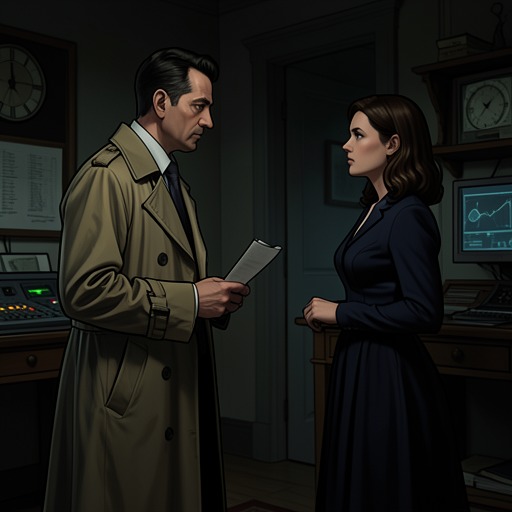
The robber’s threat is explicit: he warns the woman that he has a gun, tells her to hand over her bag, and says that a cry will get her cut in half. She makes no sound and remains still, but her breathing grows rasping as he searches the bag. Marlowe advances only after the robber has turned toward his hiding place. The man’s chuckle, rather than his face, gives him away: Marlowe recognizes it from memory and addresses him as Lanny.
Marlowe has no firearm drawn. He reaches into his pocket for a pipe and holds it like a gun, then tells Lanny that he is covered and directs him to put the bag between his feet, slowly. Lanny bends; Marlowe jumps forward, meets him as he straightens, and finds his hands empty. The bluff has changed the balance of the encounter without a shot: Lanny is no longer controlling the woman through the threat of violence, and Marlowe can take the actual gun from his overcoat pocket.
The woman is Vivian Regan, whose familiar bearing Marlowe had sensed before he could make her out clearly. The robbery’s immediate stakes are therefore personal as well as physical: the masked assailant is threatening someone Marlowe knows, in the grounds of a club connected to the case’s network of coercion and protection. The scene does not establish why Lanny targets Vivian or what he hopes to find in her bag; it shows only the attempted taking and Marlowe’s intervention.
Having disarmed Lanny, Marlowe tells him to leave. Their close, still confrontation ends not with an arrest but with a tacit bargain: Marlowe says Lanny should keep quiet and that he will do the same, then lets him go without hard feelings. The threat is stopped, but the encounter remains outside any formal process of justice. Marlowe’s choice turns a potentially violent robbery into a private settlement, preserving the case’s recurring tension between immediate protection and the compromised, unofficial methods through which its dangers are contained.
Narrative Significance
The episode belongs to a novel whose criminal economy depends on access, concealment, and uneven protection. Elsewhere, Marlowe follows Arthur Geiger from his storefront into the rain-darkened, cabin-lined streets of Laurel Canyon, where hedges mask the entrance to his house. At Geiger’s bookstore, a lending library of illicit books turns a coded list of roughly five hundred clients and a stock of books into a potentially lucrative racket: Marlowe estimates that even a cautious calculation could mean $125,000 in rentals. The attempted robbery is smaller in scale, but it likewise turns on what can be hidden and taken. Lanny’s mask conceals his identity; fog limits what Marlowe can see; the bag becomes the immediate object of coercion. Recognition breaks through that concealment, and a pipe passed off as a gun reverses the apparent advantage of the armed robber.
The episode’s setting also links elite enclosure to the exposed, compromised landscape beyond it. The Sternwood estate’s terraces descend behind a high iron fence toward the old oil field that made the family rich; much of that land has become public park, while a few wells still pump. At the Cypress Club, by contrast, the fog and cypresses make the grounds difficult to read, even as the surf sounds below the cliff. Later, the route to a disused oil field runs through a rutted track fringed with eucalyptus, past motionless derricks, rusted pipe, and an oil-scummed sump. Across these settings, private wealth, criminal dealings, and a damaged landscape occupy the same Southern California geography, though the robbery itself offers no evidence that Lanny’s actions are connected to the oil field or the book racket.
That distinction matters to the scene’s place in the larger plot. Marlowe’s investigations move among a private estate, a commercial storefront, a decaying club, and remote roads, while the threats he encounters do not always pass into official hands. The attempted robbery ends through recognition and a private understanding rather than a reported arrest. Its immediate danger passes, but the resolution preserves Marlowe’s role as an informal intermediary: he intervenes decisively, then leaves the encounter outside formal justice.
Narrative Significance
The episode belongs to a novel whose criminal economy depends on access, concealment, and uneven protection. Elsewhere, Marlowe follows Arthur Geiger from his storefront into the rain-darkened, cabin-lined streets of Laurel Canyon, where hedges mask the entrance to his house. At Geiger’s bookstore, illicit books circulate through a lending library; a coded list of roughly five hundred clients and a stock of books underpin a racket that Marlowe estimates could yield $125,000 in rentals even under cautious assumptions. Lanny’s attempted robbery is smaller in scale, but it likewise turns on what can be hidden and taken. His mask conceals his identity, fog limits what Marlowe can see, and Vivian’s bag becomes the immediate object of coercion. Recognition breaks through the concealment, while a pipe passed off as a gun reverses the apparent advantage of the armed robber.
The scene also sits within a landscape where wealth, enclosure, and exposure coexist. The Sternwood estate’s terraces descend behind a high iron fence toward the old oil field that made the family rich; much of the land has become public park, while a few wells still pump. At the Cypress Club, fog and cypresses make the grounds difficult to read, with the surf audible below the cliff. Elsewhere, a rutted track fringed with eucalyptus leads to a disused oil field of motionless derricks, rusted pipe, and an oil-scummed sump. These settings place private wealth and criminal dealings within the same Southern California geography, but the episode supplies no evidence that Lanny’s robbery is connected to the oil field or Geiger’s book racket.
That distinction clarifies the robbery’s function in the larger plot. Marlowe’s investigations carry him between a private estate, a commercial storefront, a decaying club, and remote roads; threats do not always pass into official hands. Here the danger ends through recognition, disarmament, and a private understanding rather than a reported arrest. Marlowe protects Vivian in the moment, then lets Lanny leave, so the immediate threat is contained without being converted into formal justice.